



Safety Testing Solution for New Energy Power Batteries
In the new energy lithium battery industry, ensuring the safety and reliability of batteries under extreme conditions is a core aspect of product development and quality control. Among various tests, the external short-circuit test is a critical evaluation method for assessing the risk of thermal runaway under fault conditions. This solution provides a detailed description of a standardized high-temperature short-circuit test for lithium-ion power batteries using a temperature-controlled battery short-circuit test chamber.
1. Applicable Testing Standards
This solution strictly complies with the national standard GB/T 31485-2015 “Safety Requirements and Test Methods for Traction Battery of Electric Vehicles”, particularly the requirements related to cell short-circuit testing. It also references internationally recognized safety standards such as UN38.3 and IEC 62133, ensuring both authority and global acceptance of the testing methodology.
2. Test Equipment and Key Parameters
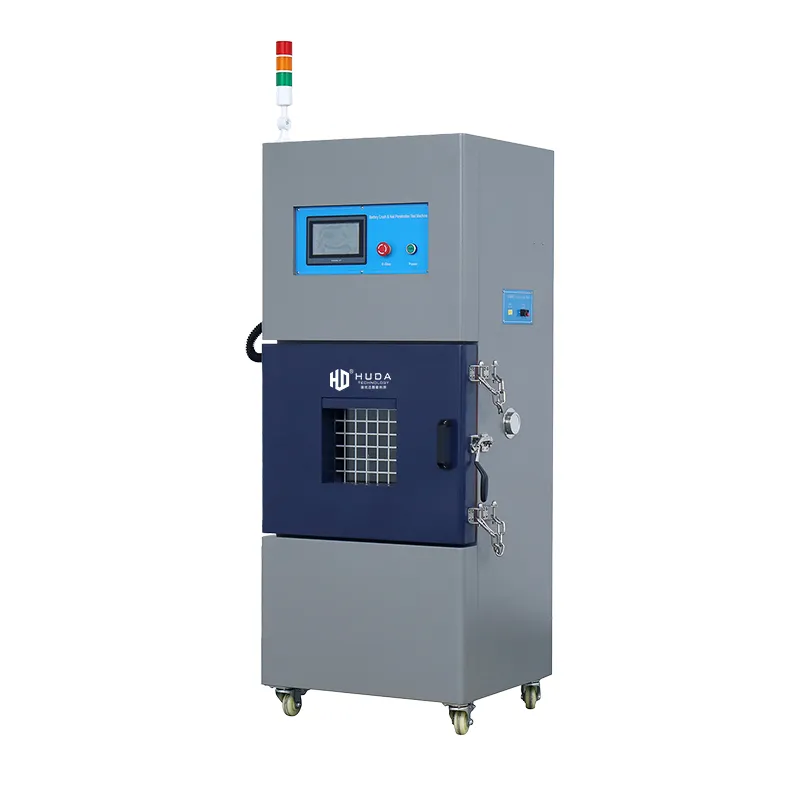
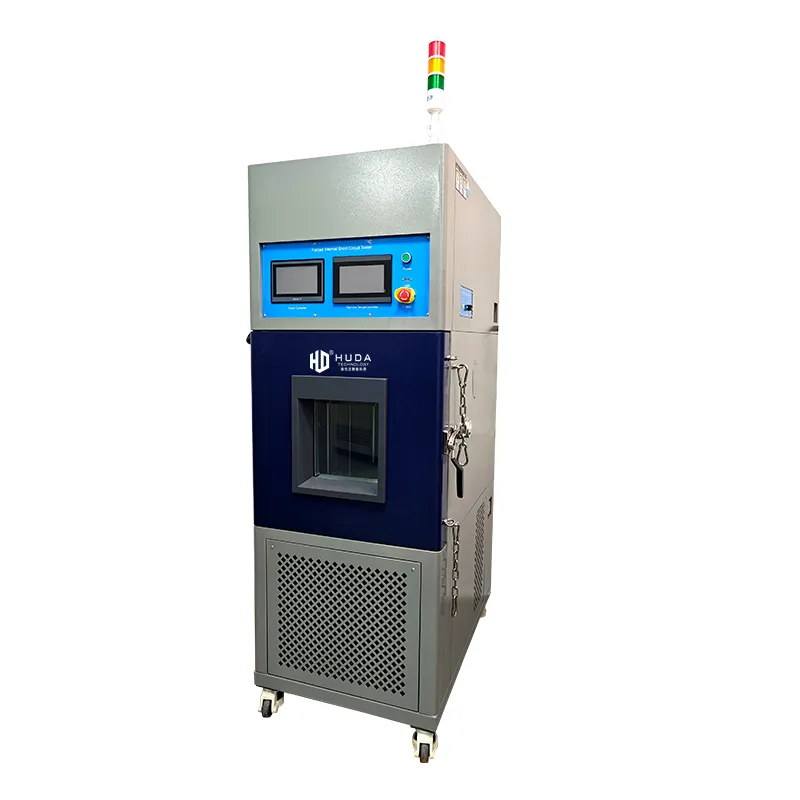
The core equipment used in this solution is the HUD-H201 Temperature-Controlled Battery Short-Circuit Test Chamber manufactured by Guangdong Huda Technology Co., Ltd. This equipment provides a precisely controlled high-temperature environment and short-circuit loop. Key parameters are as follows:
Test Temperature: 55°C ± 5°C (ambient temperature inside the chamber)
Total Circuit Resistance: 80 ± 20 mΩ (including wires, contact resistance, and all external resistances)
Short-Circuit Monitoring Duration: Up to 24 hours or until early termination conditions are met
Temperature Measurement: Real-time monitoring of battery surface temperature, range RT–1000°C, accuracy ±0.5°C
Safety Protection: Equipped with over-temperature alarm, explosion-proof chain, and smoke exhaust system to ensure test safety
3. Test Procedure
Sample Preparation: Fully charge the lithium-ion power battery according to standard requirements.
Preheating Stage: Place the fully charged battery into the test chamber preheated to 55°C ± 5°C. After the battery surface temperature stabilizes at 55°C ± 5°C, maintain the condition for an additional 30 minutes.
Short-Circuit Implementation: Inside the high-temperature chamber, connect the battery’s positive and negative terminals using dedicated short-circuit conductors, ensuring the total circuit resistance meets the requirement of 80 ± 20 mΩ.
Data Monitoring: Initiate the short circuit. The system automatically starts timing and continuously records the battery surface temperature.
Test Termination: The test is terminated when any of the following conditions is met:
A) The battery surface temperature drops by 20% from its peak value;
B) The short-circuit duration reaches 24 hours.
Result Observation: After the test, inspect whether the battery has caught fire or exploded.
4. Test Results and Evaluation Criteria
Key recorded data during the test—such as maximum battery surface temperature, time to reach peak temperature, and temperature decay curve—serve as important analytical references. According to the standard, a qualified battery must meet the following criteria:
No fire
No explosion
Maximum surface temperature does not exceed 150°C
Through precise analysis of these data, manufacturers can quantitatively evaluate the thermal safety performance of batteries, providing direct support for battery design improvement, material selection, and process optimization.
Selecting a reliable and standard-compliant manufacturer of temperature-controlled battery short-circuit test chambers is crucial for obtaining accurate and dependable data. Guangdong Haida Instruments Co., Ltd., as a professional testing equipment supplier, offers the HD-H201 model, which integrates precise temperature control, safety protection, and data acquisition functions. It fully meets the requirements of this solution and is an ideal choice for safety testing in the new energy lithium battery industry.
By collaborating with such a reliable supplier, lithium battery manufacturers can systematically complete safety validation, thereby enhancing product competitiveness and safety credibility in the market.